Overview
Advanced-Forms is, in one line, n8n for the enterprise — a visual automation platform, but for documents. Large organisations running Microsoft Dynamics, Dynamics AX, Navision, or SAP generate an enormous volume of business documents — invoices, orders, statements, contracts — and the rules for how those look, where they go, and how they're archived change constantly. Traditionally, every one of those changes means an IT ticket or an expensive call to a vendor.
Advanced-Forms hands that control back to the business. A user draws their own output process on a canvas: take the data coming out of the ERP, run it through their own business rules, lay it out, and distribute and archive it — all without writing code or filing a ticket. Quadira had been reselling software in this space, but customers kept needing capabilities the vendor wouldn't build, so the company decided to build its own. I worked on Advanced-Forms across most of my time there, going from an outsourced developer shipping a single component to the technical manager and product owner of the whole product.
The conversion core
My involvement started as an outsourced developer replacing the engine at the heart of it: a TEXT-to-XML converter that turns raw ERP output into a structured document the rest of the platform can work with. It was also the first C# project I ever worked on, and the requirements were anything but a warm-up:
- Multiple input formats, including PDF files that first had to be converted to plain text via OCR
- Full utilisation of every available CPU core to keep throughput high at enterprise volume
- A large set of business rules to parse messy, unstructured text into clean, structured XML
In only a few months I delivered a replacement that met those requirements and was good enough to sell. Because it was now built in-house, Quadira no longer had to share revenue with the original vendor — so the project paid for itself and then some.

From config files to a visual designer
After that I joined Quadira permanently. The platform already let customers shape their output, but through a text-based configuration tool — powerful, yet once a process grew large those files became almost impossible to keep an overview of. That's the gap that kept Advanced-Forms a tool for specialists rather than for the business users who actually owned the documents.
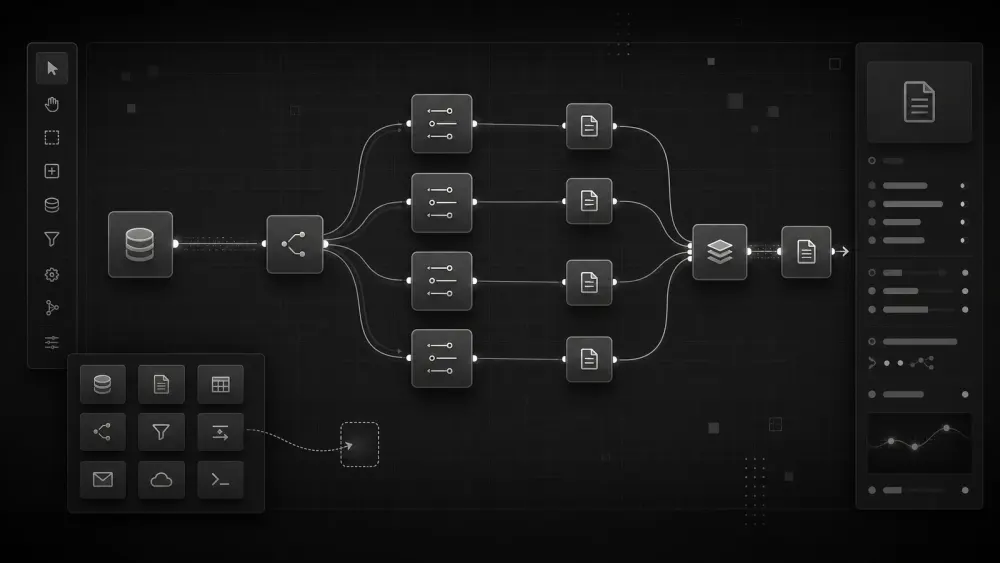
So I built the visual designer. Customers could now lay out their whole document process by dragging components onto a canvas and wiring them together — pull in the ERP data, branch on their own business rules, compose the layout, then route and archive the result — no config files required. It's the piece that turned Advanced-Forms from "configurable by an expert" into "designed by the person who owns the document." Here it is in action:

Leading the product
The team eventually grew to twelve developers, and I took a leading role as technical manager and product owner. By working closely with customers, partners, and ERP consultants, we shaped Advanced-Forms into a viable, cost-effective replacement for the expensive document-output stacks sold by Microsoft, SAP, Oracle, and HP — giving enterprises the same capability at a fraction of the cost, and putting it in the hands of the people who use it every day.